
Classic Ampeg tone in a Compact 5 watt package
Ampeg GVT5H 5 watt head
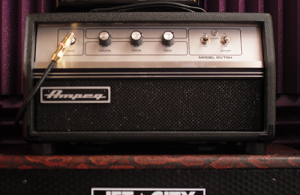 I don’t know if I really needed it, but I finally talked myself into pulling the trigger on an Ampeg GVT series tube amp. I wasn’t looking to replace my Jet City JCA20H, that will never happen. I just wanted a really low wattage tube amp so I could really push it anytime I want day or night. This turned out to be one of my better decisions. I snagged a GVT5H which is the 5 watt head, and this little thing really cooks. The first thing I noticed was the build quality. Typical Ampeg rock solid construction. Definitely styled after the iconic models of the past (think SVT). For what it’s worth, this amp is made in Korea (not China), and I have no doubt Ampeg is riding shotgun on the build process. “So how does it sound” you ask? It sounds like an Ampeg. One thing that makes Ampeg sound the way they do is the Baxandall EQ. The way the tone and bass work is hard to get your brain around, but I had an SVT many years ago so I knew what to expect. To over simplify it, they work within their respective frequency ranges and don’t overlap. They each work as a boost and cut and you utilize their settings to push the midrange. And the tone is without a doubt classic Ampeg. Gobs of clean head room through almost the entire volume sweep. You’ll get a little breakup starting around 7 but it still remains cleanish even at full throttle. But that’s what sets this amp apart from the long list of low watt tube amps on the market now. It really comes into its own as a pedal platform. It loves pedals. I dropped my MXR M77 Overdrive in front of it and it was instant 70’s Stones grind. Same with my Sparkle Drive. Either pedal is a great match for this amp but the one that really takes it over the top and makes you say “Holy Shit” is my EQD Crimson Drive. Volume wise it gets loud. Really loud. And it will take a lot of speaker setups. You can run the following.
1 x 4 Ω cab
1 x 8Ω cab
1 x 16Ω cab
2 x 8Ω cabs
2 x 16Ω cabs
I was running it through a 2×12 closed back 16Ω cab loaded with a pair of vintage Eminence speakers, but then something magical happened: I came up on a brand new 16Ω WGS 12″ British Lead 80 that I installed in a Jet City 1×12 closed back cab. I fired it up and “holy crap” it sounds freakin’ amazing! So that’s how I’ll run it. I can’t even imagine it sounding better.
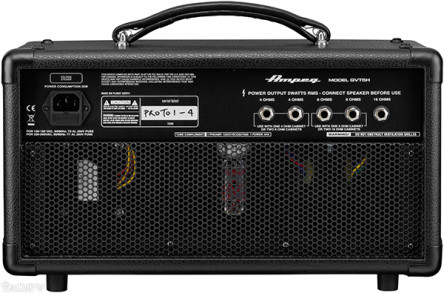
I got it used and it came with a Ruby 12AX7 preamp tube and a 6V6GTEH output tube installed but the dude also threw in 2 GE 6V6GT black plates. First thing I did was to replace the Ruby with my favorite preamp tube, a MESA SPAX7-A, then I tried both output tubes and they all sound good with the GE’s being a little smoother than the EH’s. If I was to rate this amp on a 5 scale it would get a solid 5 IMHO. If I could add one thing to it I would go for a second gain stage (or even a master volume) just so I could drive it without using a pedal at all. And if I ever run across a diy modder that knows this model and can give me some direction then it just may get that extra gain stage. But if not I’m still more than happy with it. And if there are any modders willing to take a look I have the schematic.
What I find really sad is that it appears Ampeg has discontinued the GVT series as of Jan 2014 (they still show them on the website but the link for “find a dealer” as well as the “buy now” link produce “0” results). Seems every so often they try another run at the guitar amp market but just can’t get close to the success they’ve had with their bass amps. Could be because they didn’t promote them very aggressively. Bottom line is if you get the chance (and a low wattage ass-kickin amp is on your radar) grab one while you can.
Rebuilding Epiphone SG Jr
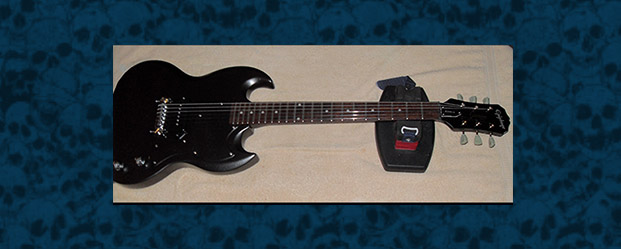
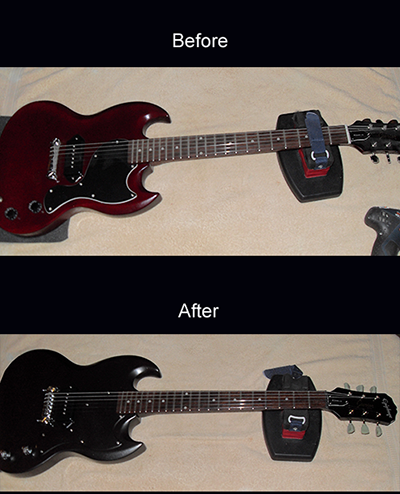
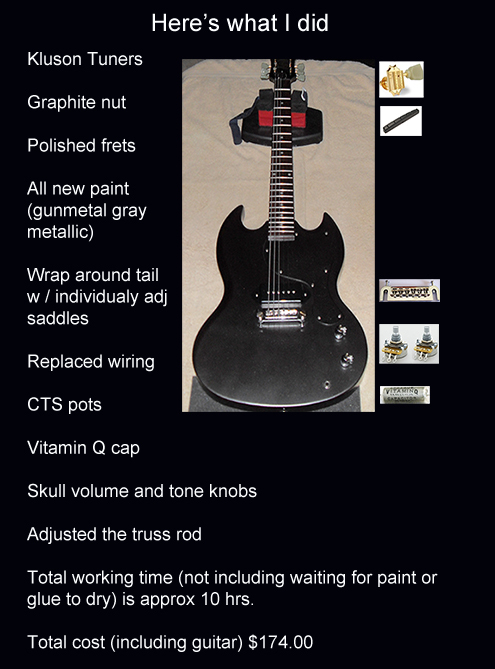
Out of the blue I decided I just had to have a p-90 equipped axe, but I didn’t want to spend a lot of money. So I hit the trail and located a 97′ model Epiphone SG Jr. It was a little rough but it was intact, and the price was right ($85.oo) I bought it Friday night and rebuilt it on Sat and Sun and was playing it Sun night. See image at the bottom of post for a list of what went into it. Oh yeah, I almost forgot, it actually plays great and it’s got tone for days!
(sorry about the crappy pics, my digital camera has started acting weird. As soon as I get a replacement I’ll put up some sharper images)
Related articles
- Sir Paul McCartney interview: ‘I’m telling my entire life story here’ (991.typepad.com)
- Revelator – Gillian Welch (solos by David Rawlings) (songsfromsodeep.wordpress.com)


Blackberry Smoke Just Might Save Rock & Roll
Blackberry Smoke
 I just recently stumbled on these guys on youtube and was completely blown away! Some people say “rock is dead” but that simply ain’t true. I admit it was starting to look bleak, but Blackberry Smoke could be the ones to save it! They are one of the best new bands I’ve heard in a long time. Ok, they’re not exactly new and they’ve paid their dues in the bars all over Georgia (their home turf). The music is straight up southern guitar driven rock and roll with a big heap of country piled on top. The closest I can come to a comparison would be the Allmans, Lynyrd Skynyrd, the Outlaws, and Charlie Daniels Band all mixed together with a healthy dose of ZZ Top slathered all over the mix. And that description doesn’t do them justice because they don’t sound like any of those exactly, they shine all on their own. How many bands do you know of that can take a traditional bluegrass song like “Constant Sorrow” (Soggy Bottom Boys) and play the first verse and sound very close to the original, then launch into a major rocked-up version for the rest of the song? Blackberry Smoke does it with ease! And to top off the whole thing: their guitars are just dripping with tone. Check them out on youtube or at their website www.blackberrysmoke.com/ You won’t be sorry you did.
I don’t generally go on about too many bands (which is ironic) but these guys are totally bad-ass and fresh and you ought to check em’ out. Go to my Video page for a couple of real rockers.


Electro Harmonix East River Drive Overdrive
All overdrives are not created equal
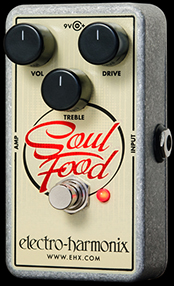
Sometimes the “hype” or just the brand name is enough to generate interest in a new product especially in the world of guitar effects. Such is the case with the Electro-Harmonix East River Drive Overdrive (advertised as a Tube Screamer clone more or less). The description sounded good, and the reviews, while limited, were pretty good, so I pulled the trigger on one ($58.99). Bad decision. I have never been so disappointed in a new stomp box and especially one from E-H. To be fair there was 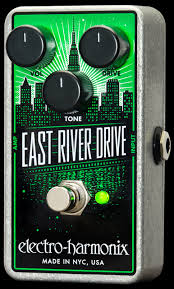 only one aspect of the thing that turned me off. Unfortunately it’s the first thing you notice when you kick it in gear even before the tonal characteristics. The volume drop. It’s pretty severe. I tried cranking it up and barely got past unity even at full volume. I’ve never had an overdrive that didn’t boost the volume with headroom to spare, although some had MORE on tap than others. The point is a drive with no volume boost is of no use to me. E-H has always put out a good product at an affordable price so maybe it was bound to happen that one would fall short of expectations, I don’t know (NOTE*: FWIW it’s also entirely possible that I got a defective unit). But don’t think that I’m writing E-H off. In fact they have another new release that I am going to take a run at later this week, it’s the new “Soul Food” overdrive. Early reviews compare it to a Klon. Stay tuned for a review on that one.

My Jet City JCA20H – 4 Years of Tone Soaked Bliss
My little tone monster’s 4th birthday!
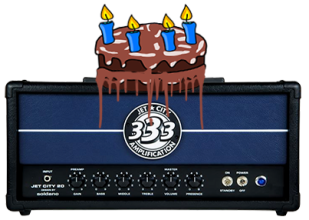 It was 4 years ago today that I hauled ass to G.C. here in Phoenix to grab a Jet City JCA20H. I say “hauled ass” because I had been watchinig the news feeds for an indication that Jet City had shipped their first amplifiers. It was 3 or 4 months previous that I found out about this new company that boasted Michael Soldano as one third owner and that he designed the flagship model JCA20H. With promises of “100{c30863b33595577c5ed4837af2f5c015c450d3942ad00dad7003b8bc2d2ae483} Tube Tone and 0{c30863b33595577c5ed4837af2f5c015c450d3942ad00dad7003b8bc2d2ae483} Bullshit” at affordable prices they had my undivided attention! Then I got wind that they had shipped the first units. I called G.C. and found out that they only had one left, which explains the “hauled ass” statement. I also grabbed a couple of the JCA12S cabs to complete the package. Just for reference, over the years I’ve used a bunch of different amps (all tube of course). From MusicMan, Kustom, and Peavey, to Fender, Marshall, Mesa, and Ampeg. All good amps for sure. I never had one that I would call bad, they’re just all different. Like most of you I’ve been on a quest for that elusive “tone” the entire time. The Ampeg came the closest, but it was a 300 watt monster SVT with the 8×10 cab (I paid $275 for it in 1975). Not very practical for an apartment dweller. I gotta say even though the sound pressures were freaking brutal (I think the term “ear bleed” was coined for this very amplifier), the “tone” was unreal. Fast forward a couple of years (33 years actually) and I have my little tone monster and I couldn’t be more pleased. It nailed that tone in my head spot on. I bought it without trying it in-store simply because I
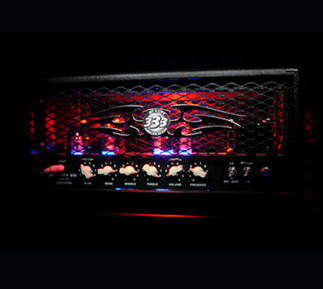
 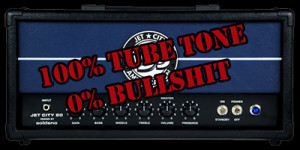 had convinced myself that if Soldano put his name on it then it had to meet a certain level of performance and quality and I love his hand built creations, so with a WTF attitude I bought it and here we are. It’s gone through a few modifications here and there. Started with the cosmetic stuff like the steel baffle, LED accent lights, and burghundy snakeskin Tolex, then the internal stuff like the tone stack mod, a depth mod and a choke. It goes without saying that I went through some tubes to really dial in the tone like we all do when we get a new amp. So after 4 years what’s my opinion of this little beast? Put it this way: I never hung on to ANY amp for more than a year, maybe year and a half because I had to keep looking for “the right one”. 4 years on and it’s still with me. On a scale of 1 to 10 the Jet City JCA20H scores the coveted “11” in my book. And just like everything else “tone” related, YMMV.
Easy Loose Vacuum Tube Repair
Quick fix for a sloppy vacuum tube socket
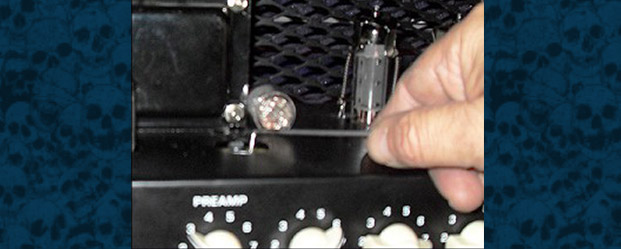
Vacuum tube sockets are generally pretty sturdy, unless you change tubes frequently. And let’s face it: when the quest for tone bug has it’s teeth in you, the odds are you are going to try different tubes and/or tube combinations. Nothing wrong with that as it’s a time honored tradition among guitarists. What it leads to, unfortunately, is the occasional loose tube. This can be frustrating when they break contact intermittently. Each pin on the tube slides into its own little hole in the socket and inside that little hole is a split metal contact that grips the pin by tension from that contact.
Over time, even if you don’t change tubes alot, those contacts get spread apart to the point they no longer grip the pin and that’s where the trouble starts. But I have a super simple method for restoring that gripping action with a quickness. 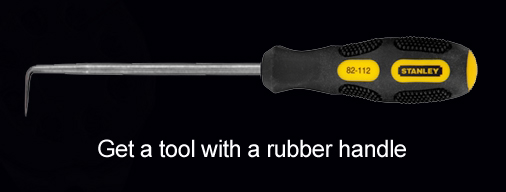
All you need is a tool like in this picture. This paticular tool came in a set that has a straight tip, a hooked tip, a 45 degree tip, and the one I use for this repair, a 90 degree tip. You can actually make one but it’s going to need a handle for gripping and twisting as you will see.
(WARNING: (you’ve no doubt heard this before but for both our sakes here it comes again) tube amps contain lethal voltages that can kill you. And I mean tag-on-the-toe dead! Always drain the capacitors of these voltages before venturing in, and keep one hand behind your back while working in there. If you are uncomfortable working around these hazards, don’t. If you just plain have no idea what you are doing, you need to learn first. There’s a ton of info on this subject all over the net.
This is for a head. If you have a combo you will need to transpose for that type amp.
The process is simple and there are two methods.
Method #1 (for amps that have bleeder resistors to drain the capacitors):
Turn off the amp and unplug the power a few hours berfore attempting this repair.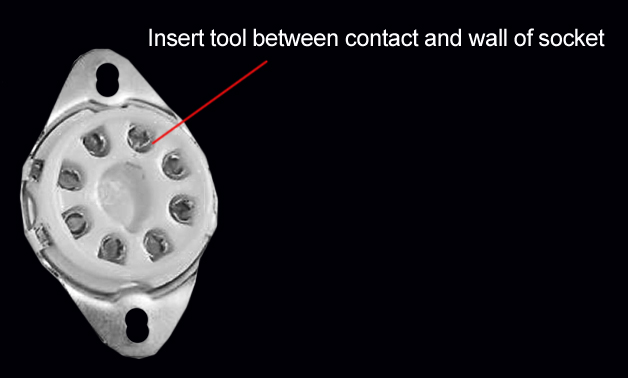
1. Remiove the front baffle form your amp
2. Remove the tube(s) that is loose
3. Starting with Pin #1, insert the tool into the pin hole to the outside of the metal contact
4. Gently twist the tool towards the center of the pin hole.
5. Now insert the tool on the other side of the same contact and twist towards the center again.
6. Repeat for each pin hole then go on and do the rest.
7. Repeat the process for any other sockets that were sloppy.
You don’t have to Jethro the thing, be gentle cause those contacts bend super easy and overdoing it could deform them or even break them and you don’t want to have to replace the whole freakin’ socket.
Method #2 (amps without bleeder resistors)
1. Pull the chasis and drain the caps (see warning above)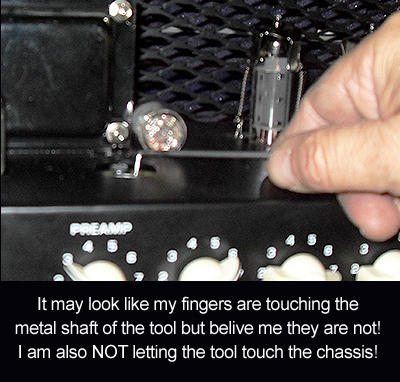
2. Perform steps 2 thru 7 of Method#1.
That’s it except you should get some electronics parts cleaner and clean the pins on the tubes while your in there. They get oxidized so it helps a lot with contact.
Replace your tubes and button up the amp, fire it up and rock out!

MXR Custom Badass Modified O.D. Pedal
MXR Custom Badass Modified O.D. WTF? Another Overdrive?
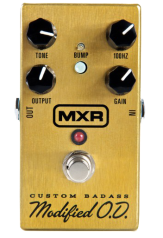
Ok, now that I’ve had the Badass Modified O.D. for a few days I can make a reasonable assesment on it. First thing is that it absolutely does what the mfgr. says it does. The range of tones is huge, thanks in part to the 100HZ knob and the “bump” switch. Note separation is good any settings and the tone knob is useful throughout its sweep (it doesn’t cut lows like some pedals). The only wrinkle is how it acts with other dirt pedals. It doesn’t sound too good with the Barber Burn Unit or the Akai Blues Overdrive at all. It likes the Open Road pretty well, but it LOVES the Voodoo Lab Sparkle Drive. With the MXR in front of the VLSD it sounds incredible. And I have to credit the VLSD “clean” knob for that. Here are the settings that I have found to worked for me. I am including them to give you a starting point. (YMMV):
Badass O.D.
Output: 11 o’clock
Tone: 3 o’clock
100HZ: 2 o’clock
Gain: 1 o’clock
Voodoo Lab SD
Gain: 3 o’clock
Tone: Cranked
Clean: 11 o’clock
Vol: 1 o’clock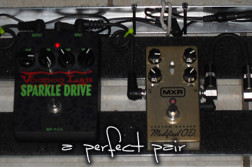
And just like everything else tone related, this is all subjective since what sounds sweet to my ears may be fingernails on a blackboard to someone else. But I can’t help but think that this would be a welcome additon to any pedalboard.

Jet City JCA20H Front Baffle MOD
Jet City JCA20H Baffle MOD using expanded metal.
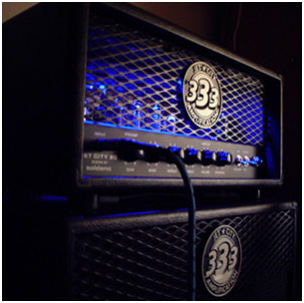
I bought my Jet City JCA20H the week they hit the stores, and I bought it without test driving it. I never considered it since the thing was designed by Soldano, plus everything I had read leading up to the first shipment going out was all good. I was not wrong. This is one of the ballsiest straight up rock & roll amps I’ve ever plugged into. After dialing it in with a tube upgrade and a minor internal mod I decided it needed a facelift. What i came up with was the expanded metal like Soldano uses on his mega-buck models. And it should work for most tube amps with some minor adjustments. It definitely gives the amp a “SOLDANO” vibe (fig. 1) while increasing the airflow to the tubes. So it isn’t strictly cosmetic. And with this type of baffle you can add LED lights to illuminate the tubes and other shit inside. The whole thing costs about $30 but you get enough materials for two baffles. So you can make one for the back side of your amp or make one for a buddy. (click image for larger view) I also put a video up on YouTube a long time ago, but you’ll get more detailed information from this article. If you want to check out my video, here’s a link to it. JCA20H_baffle_MOD
Expanded metal at Home Depot (fig. 2)
What you’ll need to do this mod:
- Expanded or perforated metal at least 6″ x 20″
- 1/2″ coupling nuts with 6-32 internal threads. (4)
- 1″ course thread screws (drywall screws work pretty good for this) (4)
- Computer case thumb screws (4)
- Dremel with reinforced cut-off wheel (good tin snips will work if you don’t have a Dremel)
- Medium to fine metal file (1 or 2 of each)
- 100 grit and 400 grit sand paper
- Masking tape (painters tape if possible so it doesn’t leave any residue)
- Lacquer thinner (or some kind of solvent. Alcohol works in a pinch)
- Self-etching automotive primer
- Black spray paint. Flat doesn’t look to good but semi-gloss or high-gloss will work just fine.
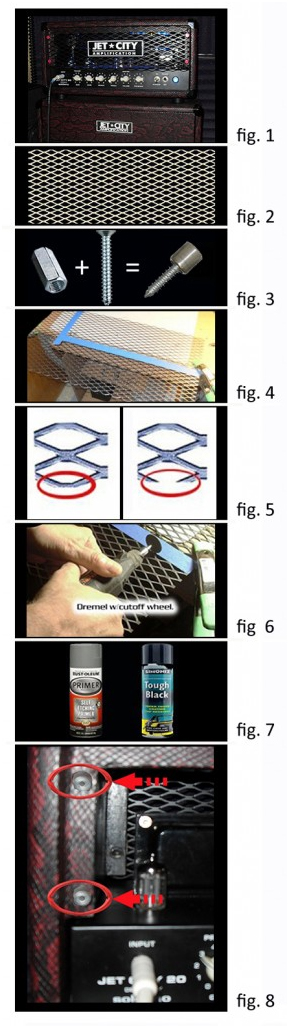
Start by removing the factory front baffle by accessing the screws from the rear of the amp. Check the opening for size. For the JCA20H it will be 17 7/8″ x 5″. The 5″ height measurement puts the lower edge of the new baffle even with the top edge of the chassis. I added 3/8″ to mine so it would extend just a bit lower than the chassis. And If you want to roll the edges inward you need to add a little all the way around to compensate.
Clean the new metal with solvent to remove the coating of oil. Then figure your cut lines and tape them off (fig. 4). The tape will act as a guide for cutting. Clamp it down tight to a solid surface and cut along the tape with the Dremel (or tin snips). (fig. 6)
NOTE: Watch out that you don’t mark it to cut in such a way that it will leave razor sharp points along the upper or lower edge. They not only look bad, but they’re freakin’ dangerous too! (fig. 5)
Once that’s done take a file and clear any burrs or sharp pieces of metal from the edges. Then sand both sides with 100 grit paper followed with 200 or 400.
Primer both sides and let it dry. Then apply the color coat. Several light coats with adequate drying time between coats will give better results.
Next, cut the heads off the 1″ screws (fig. 3) and force thread them into the coupling nuts. You may need to hit the screws with a file just a little to make this easier.
Hold the new baffle against the face of the amp and mark 4 mounting locations with a scratch awl of a Sharpie marker. Drill a hole at each mounting point and screw the coupling nuts down tight. (fig. 8)
Hold the new baffle against the coupling nuts and fasten it in place with the knurled thumb screws.
That’s it. All that’s left is to reattach your Jet City badge and you are ready to rock.
In my next post I’ll show you how to install LED lights. And I’ll show you how to power the LEDs internally from the amp, including an on-off switch so you don’t have to use an external power adapter.
Heres a short video
Gibson Les Paul Brass Bridge and Tailpiece Replacement
Solid Brass Bridge and Tailpiece
An investment in Tone!
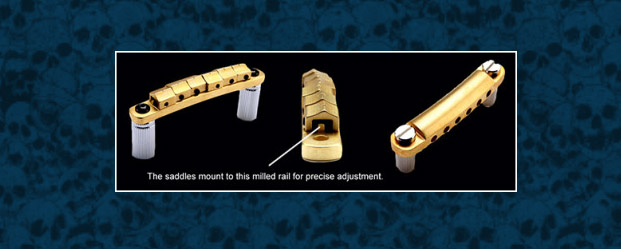
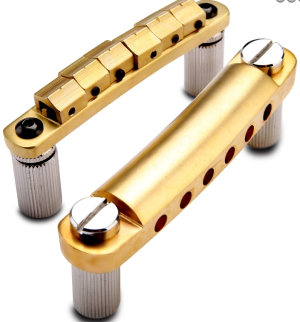
 This is not meant as a tutorial OR “how to” on Les Paul Bridge Replacement, lots of those on the net. This article is more about the sonic benefits of replacing the factory setup with something better. After dealing with some minor issues with the factory hardware, and countless searches on the net, I opted to install the solid milled brass bridge and locking tailpiece from Guitar Fetish. There are several unique features that made this set up worth checking out. To begin with, each piece is milled from a solid block of brass. The saddles on the bridge are mounted on a solid rail by set screws front and back on each saddle and are designed for precise intonation adjustment. It’s milled with a slight arch to match the radius of the fretboard. This unit also uses a direct solid mounting system which bolts it directly to the body which equates to an increase in sustain.
The stopbar tailpiece is also quite unique in several ways. First it also bolts tight to the body. But the most unique feature is the slight bow making the A-D-G- and B stings just a fraction longer with the high and low E strings anchored at normal length. I don’t quite understand the theory behind this, but it definitely makes chords resonate a bit more and it makes intonation more accurate as well. A major side benefit is that it eliminated having to raise the stopbar tailpiece high enough to keep the strings from contacting the back side of the bridge, which caused all kinds of issues especially with sustain. When you break it all down, the overall design is kind-of a no-brainer. As few moving parts as possible, mill the whole thing from solid brass and bolt everything tight to the body. It just works
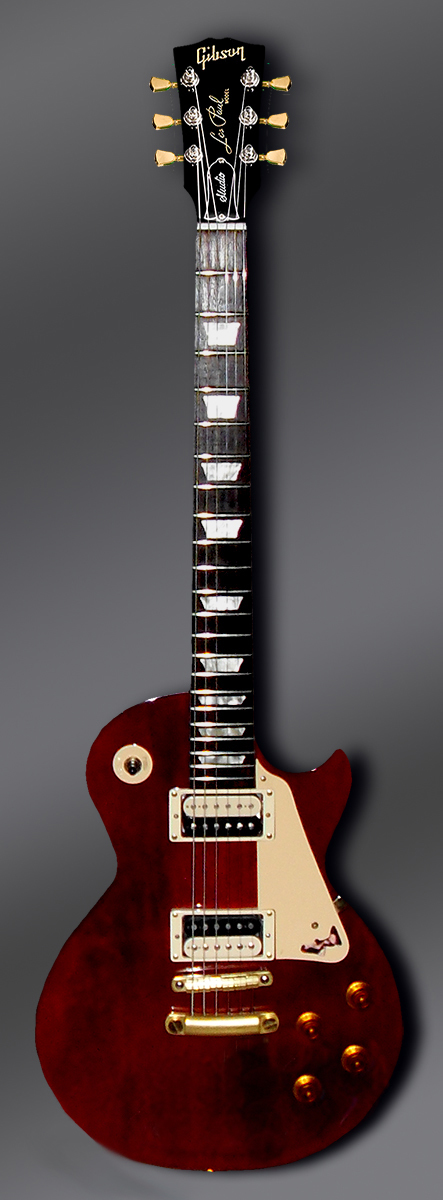
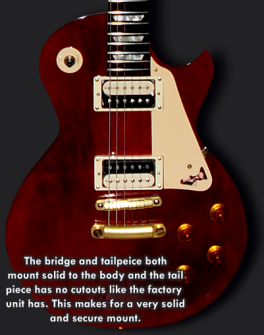 I run my Gibson Les Paul Studio through a Jet City JCA20H with just a Voodoo Labs Sparkle Drive, an MXR Custom Badass Modified O.D. and a Biyang Tri-Reverb and I can pull any sound I could ever want out of her. Like I said, I had issues with raising the tailpiece but this mod corrected the problem and the sustain is off the hook!
Since I have had this modification on the guitar for well over a year now I suppose I can make an honest assessment, and the best way I know to do that is to say this: If I went out and dropped $8000 on a Gibson Les Paul today, by tonight my order for another bridge and stop tailpiece set would already be confirmed. That’s how much of an improvement this unit makes. The guys at Guitar Fetish really knocked one out of the park with this one.

Akai Blues Overdrive Pedal
Decent Blues Overdrive
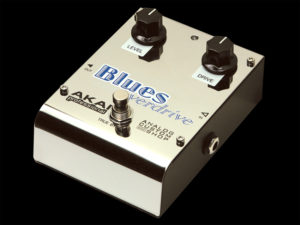 Sometimes things happen that make you scratch your head and say “WTF?”. And that is exactly what happened to me a few days ago. I had been trolling Craigslist for a few weeks looking for an interesting pedal just to mess around with and I found something: an Akai Blues Overdrive that the owner was willing to trade for a good chorus pedal. I just happened to have a Marshall Supervibe that I hadn’t used in a while so I emailed him and voila, the deed was done!
Now let me explain about the Akai: I had done a bit of research on that pedal a while back and wasn’t too impressed with the audio clips. And I also found out that it was actually a rebranded Biyang pedal. They sold for more than double what the Biyang units went for, so I didn’t really give it another thought. But this was a pedal just to goof around with and try some different mods and just generally experiment with and if it got trashed no biggie. Long story short, I got it home and plugged it in and Holy Shit! this freaking thing sounds great! When run with my Burn Unit the combination flat out smokes! With a few twists of a knob it goes deep into metal territory. That fact really doesn’t mean much to me since i don’t play metal, but it illustrates how extreme these two pedals can get when run together. By itself, the Barber Burn Unit beats it on every front. But that’s not to say the Akai doesn’t sound great in it’s own rite. In fact, it sounds like the Voodoo Lab Overdrive with just a touch more high end response. It’s very smooth through most of the drive knobs rotation until about 2 o’clock, at which point it gets grittier and crunchier but not in an over the top kind of way. NONE of those youtube videos does this thing justice. And if it hadn’t been for the situation at the time I would never have even thought about one of these. Karma, man. Karma led me to it. Has to be, right?
The construction is pretty solid too. I’m not sure if the top half of the case is polished stainless or hard chromed, but I’ve never seen another pedal like it anywhere. I’ve had Harleys with expensive chrome jobs that were no where near this nice! (could be a negative point if stage lights ever hit it at the perfect angle cause the reflection just might flash blind you. I’m not kidding).
But just like everything else we hold dear, the tone is completely subjective to the player. What sounds like a Harley with 2″ straight pipes going flat out on an open road to me might sound like a mo-ped with bad gasoline to you. And I ain’t tellin anybody to run out and buy one of these. But If you ever get the chance to check one out you really should.
The next post will cover my other new pedal: the aforementioned Barber Burn Unit (Karma was smiling on me for that one too). As for the Akai, there will be NO experimenting with this unit, that’s for damn sure.


 Leslie West’s Favorite GuitarIn Featured, Guitars, VideosRead More […]
- A Video History of Dean GuitarsIn All Posts, Guitars, VideosEPISODE 1 EPISODE 2 Read More […]
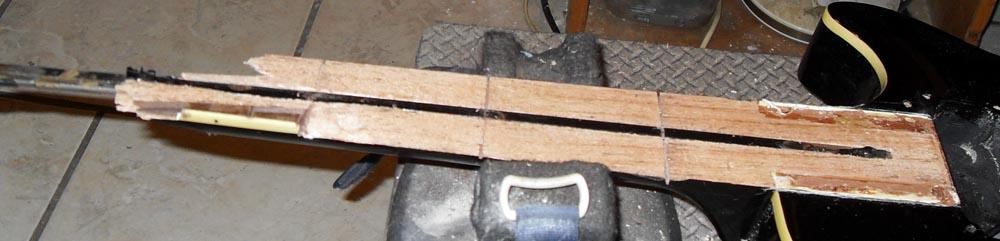 Set Neck ReplacementIn Guitars, RepairsA friend asked if I could repair a broken headstock on […]
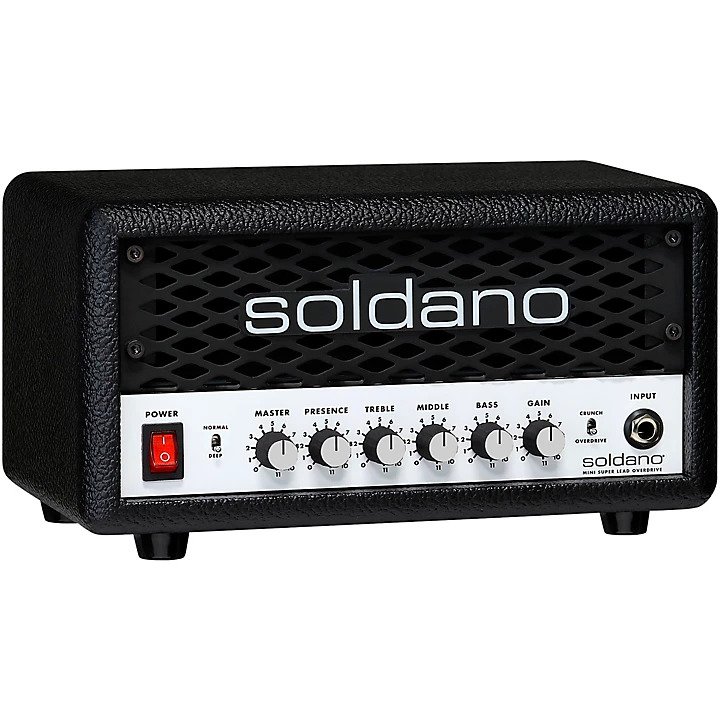 Soldano SLO Mini 30 Watt Killer AmpIn All Posts, Amps, ReviewsI have never gotten excited about ANY solid state amp. […]
 Leslie West Mountain of Tone PickupIn All Posts, Guitars, ReviewsWhen it comes to electric guitars, it’s common […]